
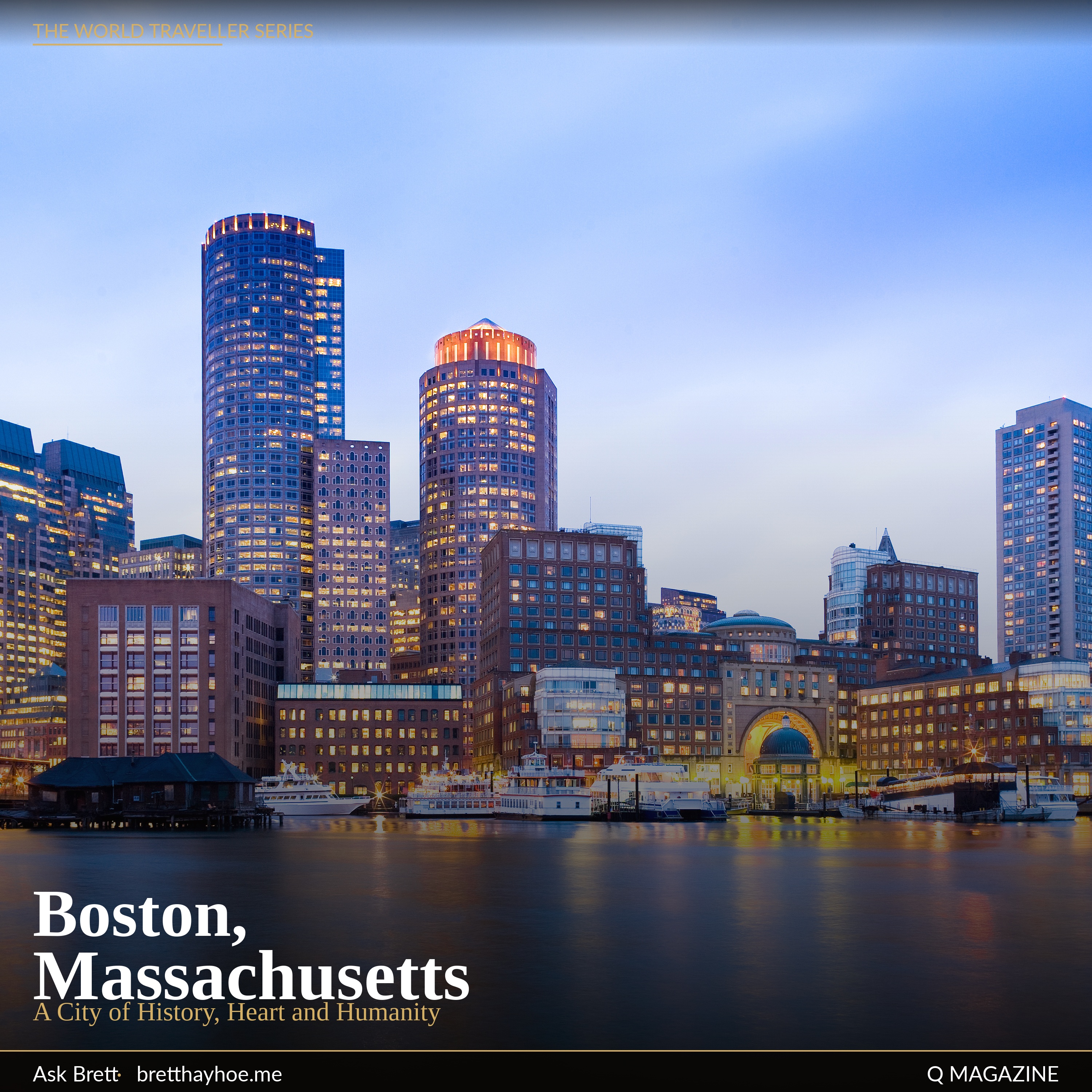
The World Traveller Series ~ Episode [19]
by Brett Hayhoe

There are cities that require a reason to visit, and cities that are their own reason. Boston is the latter — a place so layered in history, architecture and character that the question of why one might go there answers itself before it is fully asked.
It was visited more than once. More than twice. Boston accumulated visits the way certain cities do — not because they were planned, but because the city kept presenting itself as worth returning to, and the answer kept being yes.
The history needs no introduction here. It is one of the most storied cities in the United States, and the United States has no shortage of storied cities. What Boston has that others do not is a particular quality of lived-in gravity — the sense that the history is not merely preserved but present, woven into the fabric of streets that were old when the country was young.
None of that, however, is what Boston will be most remembered for. Boston will be remembered for the people.
Linda, Anna, and the Pretzel Empire

It would be an overstatement to call Linda’s family Boston royalty. It would also be more or less accurate.
Linda was the Co-President I served alongside during the final year on the InterPride board — a colleague first, and then, as these things occasionally happen when the work is shared and the trust is earned, a genuine friend. Her wife Anna came with the friendship, as the best partners of the best people tend to do.
Linda and Anna run a pretzel-making business in Boston. This is mentioned not as a footnote but as context, because the business is theirs in the way that things are only ever truly yours when they are built by hand and kept by conviction. It is the kind of enterprise that suits them entirely.
What will not be forgotten — what cannot be forgotten — is Anna’s particular gift for reading a room. Or, more precisely, reading a person. The InterPride conference circuit carries its own pressures, and stress has a way of making itself visible regardless of one’s intentions. Anna noticed. Anna always noticed. On more than one occasion, when the conference floor had taken its toll and the effort of appearing composed was beginning to show at the edges, Anna would appear quietly at the elbow and suggest, in the way that admits no reasonable refusal, a short departure to her hotel room.
There, without fuss or ceremony, she would pour a nerve-settling scotch.
The overwhelming majority of people in attendance would never know. That was, of course, entirely the point. It is a particular form of kindness — the kind that does not announce itself, that asks for nothing in return, that simply appears when it is needed most. Anna has it in abundance. So does Linda. The friendship, once made, has never required maintenance. It simply is.
Walking Boston — and the Question Nobody Could Answer

On one of those visits, Alan and a couple of hotel rooms on the outskirts of the CBD, and then the rest on foot.
Boston was walked for several hours. The visual history of the place presented itself generously — around every corner, in every street name, in the particular weight that old cities carry when they are also proud of what they carry. It was thoroughly and happily absorbed.
At some point, walking and looking and absorbing, an observation that had been forming for some time finally found its way out into the open air.
Where are all the people of colour?
Alan didn’t have an answer. He shared the observation, and shared the puzzlement. That evening, over dinner with some of the local Pride committee members, the same question was posed. It received, from each of them, the same response: a shrug. A slight widening of the eyes. An absence of answer that was, in its own way, answer enough.
The question sat unanswered until later that same day, when we entered Quincy Markets. There is a huge food hall in this historic building with 50+ eateries, vendors & kiosks with diverse offerings.
Inside was a sea of faces — Asian, Indian, African-American, every nationality imaginable — preparing and serving food with the kind of energy and pride that instantly explains why the smell alone, hitting from the footpath outside, had been enough to stop a person mid-stride. The food was some of the most delicious eaten anywhere in the United States.
The observation, offered to Alan quietly as the scene registered, has never been improved upon: here is the answer. They are good enough to make the food. Just not good enough to reside next to.
It was perhaps a tad disingenuous. It was also accurate. This is not a criticism so much as a reckoning — for a city so rich in the history of liberty and revolution, so architecturally magnificent, so culturally layered, the separatism of centuries past was not difficult to find if one cared to look. Boston wears its history proudly. Not all of it, apparently, equally.
The LGBTIQ+ Scene

Boston’s LGBTIQ+ scene is alive, well, and doing exactly what a good scene should — existing for the people who need it rather than performing for those who don’t.
Several venues were visited across the various trips. None of them were unwelcoming. All of them were friendly in that particular way that comes naturally to communities that have built something worth protecting — not aggressively hospitable, not performing for the visitor’s benefit, simply open. It is the quality that the best of these spaces share, and Boston has it.
Nothing requires specific naming here. Some evenings are simply good evenings — the kind that accumulate quietly into the memory of a place without attaching themselves to any single moment. Boston’s nights were that kind of good.
The Highway — and What Gets Lost When Roads Go Over the Top

Boston changed, across the years of visiting. Not in its bones — the bones of Boston are not the changing kind — but in its approach.
The highway used to run directly through the heart of the city. Arriving by road meant being taken inside Boston before the journey was concluded — the streets rising around the car, the history announcing itself before the bags were unpacked. It was, as an introduction to a city, entirely fitting.
At some point the highway was relocated above, bypassing the centre rather than passing through it. The engineering logic is not in question. What was lost, however, is worth noting.
A visitor arriving for Boston specifically will find their way into the city regardless of where the highway sits. But travel is not only composed of deliberate visitors. There are those passing through, those with a few hours between destinations, those who might have been persuaded by the spectacle of a city appearing around them mid-journey to stop and look. The old highway did that work quietly and automatically. The new one simply goes over the top.
Boston, seen from above on a freeway, is just a city. Boston, encountered at street level without having planned to be there, is a reminder that some of the best things happen because the road made them impossible to avoid. That version of Boston deserves more visitors than the new approach is likely to produce.
Conclusion
Boston is a city that repays every visit made to it, and punishes none of them. It is historically magnificent, architecturally serious, and possessed of a character that does not soften for the benefit of those passing through. It asks to be taken on its own terms. Those who do are generally glad of it.
What it gave, across multiple visits and multiple years, was more than architecture and history. It gave Linda and Anna — the friendship, the pretzels, and the particular mercy of a quiet scotch at precisely the right moment. It gave the company of Alan on streets that earned the walking. It gave a food hall and a question and an answer that has never been improved upon.
Cities are, in the end, people. Boston’s people — the ones known by name, the ones behind the counters of that extraordinary hall, the ones in the bars who were simply getting on with it — made the case for the city more effectively than any monument could have managed.
The verdict was a favourable one. It always was.
The World Traveller Series is written and produced by Brett Hayhoe — publisher, editor and administrator of Q Magazine. Read more at Q Magazine Blogs — Ask Brett Podcasts — Ask Brett and YouTube
Next: Indianapolis, Indiana
Discover more from Ask Brett
Subscribe to get the latest posts sent to your email.