

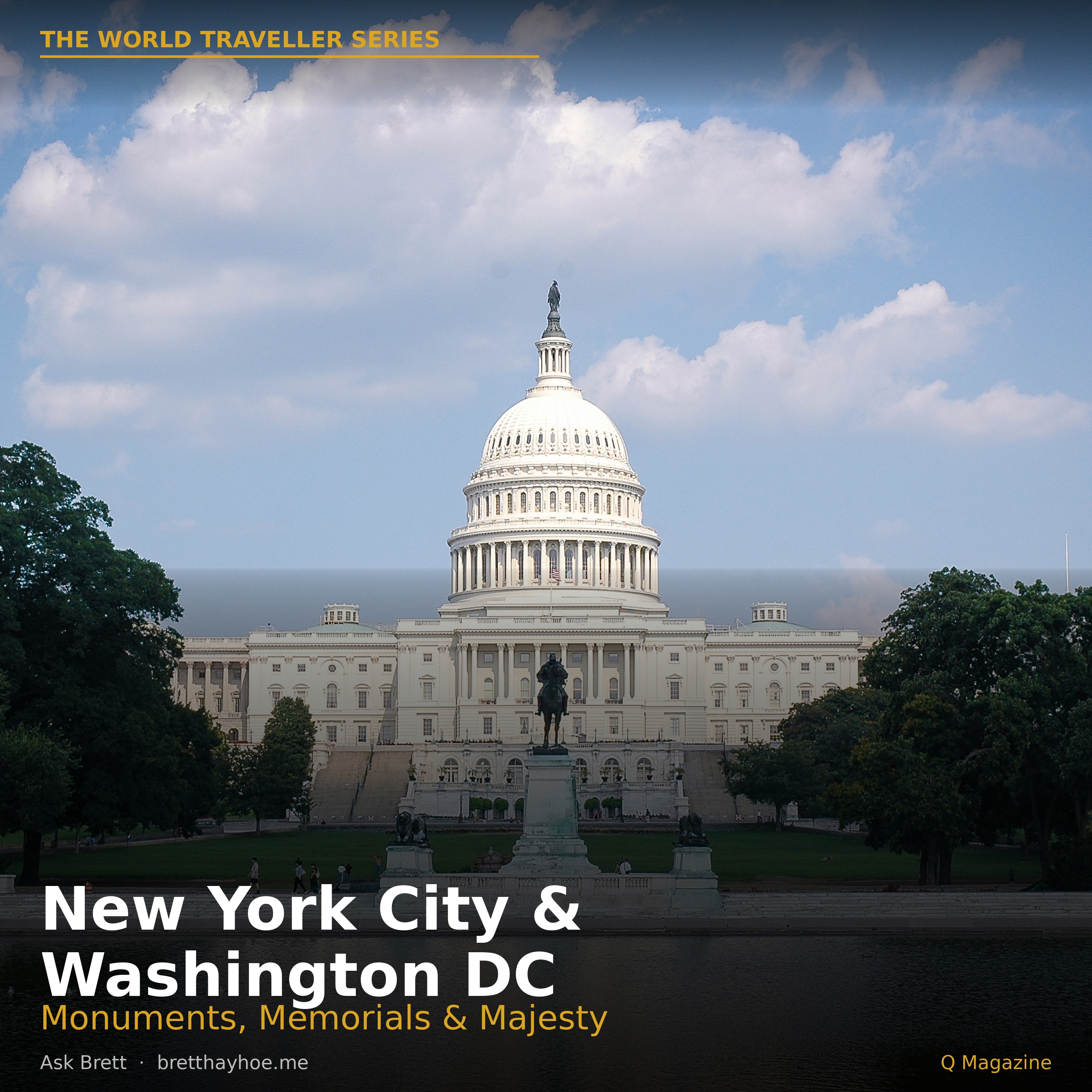
The World Traveller Series ~ Episode 17
by Brett Hayhoe

Some of the best things that happen while travelling happen in transit.
The extended stay at Long Beach Airport — a consequence of delayed flights and inclement weather in New York — produced, as has already been noted, an unplanned overnight in Houston. What has not yet been noted is what happened before the Houston detour: a conversation, in a small seating enclosure outside the terminal, with a woman who would become a dear friend for many years to come.
They met by chance — the particular chance that long airport waits produce, throwing strangers into proximity long enough for something genuine to take hold. They encountered each other again at JFK. By that point the coincidence had become something more deliberate, and lunch in New York City was arranged.
It turned out that the new friend worked in the marketing department of Kenneth Cole. And Kenneth Cole, as it happened, had been an adored fashion label for many years.
New York — A Chance Meeting and a Kenneth Cole Education
Lunch was followed by something rather better than lunch: a shopping trip to Kenneth Cole, with a staff discount extended with the kind of generosity that new friendships occasionally and unexpectedly produce.
The garments and accessories purchased that day remain in the wardrobe. They are, as one would expect from Kenneth Cole, superbly made. But their value is not primarily sartorial. They are a memory — of a particular afternoon in New York City, of a friendship formed entirely by accident in an airport departure lounge, of the specific pleasure of shopping with someone who knows the label from the inside.
The friend, over lunch, shared the origin story of the brand — one that is too good not to pass on.
Kenneth Cole began as a shoe company. The founder, wanting to sell his shoes in New York, set up a stall outside Central Park. He was told to move along — the available positions were reserved for film and television productions, not retail traders. Kenneth Cole’s response was immediate and elegant: he registered the company as Kenneth Cole Productions, which qualified him for exactly the kind of pitch he had been denied.
He sold his shoes. The company name — Kenneth Cole Productions — has remained unchanged to this day.
A clever man, by any measure. And, as a footnote that rewards the curious: it is the reason so many films open with scenes shot in Central Park. For production houses, filming there is free. The park has been a standing set for decades, and it costs nothing. Kenneth Cole understood the rules well enough to rewrite them, and the city’s cinema geography has been shaped by that understanding ever since.

The Road Trip — Alan, Paul and Washington DC
Over the years of visiting the United States, Alan and Paul became the constants — the friends around whom road trips organised themselves, the companions who made the driving as enjoyable as the arriving. Those road trips are among the most fondly held memories of the travelling years. They are missed, in the particular way that experiences tied to people who are no longer present tend to be missed — not just for what they were, but for the fact that they cannot simply be repeated.
One such trip was to Washington DC. The drive from New York is, surprisingly, not especially long — the distance between the two cities that loom largest in the American imagination turns out to be considerably more manageable than their respective mythologies suggest. The road there is straightforward. What waits at the end of it is not.
Washington DC — Monuments, Memorials and Majesty

If ever there was a place in the United States deserving of the word majestic, Washington DC is it — and the word does not feel overstated.
The city operates under a design principle that gives it an architectural character unlike any other American city: no building may exceed the height of the Capitol. The result is a city that breathes — low, wide, open to the sky, its monuments rising without competition from the surrounding streets. After the vertical ambition of New York, it feels like a different country entirely.
The monuments were visited and absorbed. The Vietnam Veterans Memorial — that long black wall of names, sunk into the earth rather than raised above it — carries a weight that cannot be adequately described in advance. It must be stood in front of. The museum was visited, and its sadness sat where sadness tends to sit: quietly, and for some time after.
One observation deserves its moment: the memorial to Dr Martin Luther King Jr — arguably the most singularly famous Black man in the history of the world — is carved from white stone. It is a decision that invites a question no one has satisfactorily answered in the intervening years. The monument is striking. The choice of material is striking in a different way entirely.
The White House is, in these times, accessible only from a distance — gates and security having become permanent features of a landscape that was once considerably more open. From outside the fence line, however, the grandeur remains. There is something in the proportions of the building that insists on being taken seriously, regardless of one’s views on what happens inside it.
The pronouncement made to Alan — that every school child should be required to visit Washington DC at least once during their formative years — was not hyperbole. The city is a physical argument for the importance of history, told in marble and water and open sky. As an Australian visitor, the understanding and appreciation of the United States deepened considerably in the course of a single long weekend. Whatever one’s politics, the place earns its reverence.
The Gay Bar — Bears, Birthdays and a Human Puppy

Washington DC’s gay scene was represented, on this particular evening, by a leather bar — somewhat hidden, considerably large, and very much its own world.
The host for the evening was the then-President of Washington Pride, who arrived accompanied by his puppy. The human kind. This detail sent Alan into a state of something approaching apoplexy, which was, it must be said, rather entertaining to observe from a slight remove.
Upstairs, a birthday was in progress. The room was long and rectangular, lined with podiums that on an ordinary night would host go-go dancers. On this particular night, the podiums were occupied by bears — large, cheerful, unapologetically present, and wearing g-strings that left very little to the imagination.
It was magnificent. The nuance was not missed. The energy was extraordinary. Washington DC, it turns out, contains multitudes — and the contrast between the marble gravity of the monuments and the joyful, warm, entirely unself-conscious chaos of a birthday party in a leather bar upstairs is one of the more perfect distillations of what makes the city interesting.
Arlington — Rows of White

Arlington National Cemetery was the final entry on the itinerary, and the one that stays longest.
The scale of it is the first thing. Row upon row of white headstones, identical in form, stretching in every direction across grounds that are impeccably, reverently kept. The individual graves of presidents who have passed — marked with a quiet dignity that the office perhaps does not always reflect in life — sit within the larger expanse without demanding particular attention. Everything here is part of the same thing.
To walk through Arlington is to understand, viscerally and without argument, what the cost of certain decisions looks like when rendered in stone and grass and silence. It is one of those places that does its work on you without announcing what it is doing.
A true highlight. The right word for it.
Conclusion
Washington DC and New York City are, individually, among the most significant cities on earth. Encountered together — connected by a road trip with dear friends, bookended by airport coincidences and Kenneth Cole shopping and birthday parties in leather bars — they become something more personal than significant. They become a chapter.
The garments from that New York afternoon are still in the wardrobe. The white headstones of Arlington are still in the memory. The bears on the podiums are, it is fair to say, also still in the memory — filed under a different category, but present nonetheless.
Alan and Paul made those road trips what they were. The road trips made the destinations what they were. That is, in the end, how travel actually works — not destination to destination, but person to person, conversation to conversation, chance encounter to chance encounter, all the way home.
The World Traveller Series is written and produced by Brett Hayhoe — publisher, editor and administrator of Q Magazine.
Read more at Q Magazine Blogs — Ask Brett Podcasts — Ask Brett and YouTube
Next: More USA entries to follow.
Discover more from Ask Brett
Subscribe to get the latest posts sent to your email.