
The World Traveller Series
by Brett Hayhoe

Every journey has a beginning. Not merely a first destination, but a moment — a single decision, or sometimes a single piece of paper — that sets everything else in motion.
For this particular traveller, that moment arrived not at an airport or a departure gate, but in the middle of a filing exercise.
Pride March Victoria had been administered for a very long time by the same steady hands — Penny and Liz, who managed it with a brilliance that made the complexity look effortless. A change of guard, when it came, was inevitable. What followed was the forensic sorting of decades of accumulated paperwork, the kind of archival excavation that organisations periodically require and rarely enjoy.
It was through that process that a previous attendance at the InterPride AGM and World Conference in New Zealand came to light. One thing led to another. The board decided to send a representative to the next conference.
The next conference was in Zurich.
I had travelled before, so that aspect held no particular anxiety. InterPride, however, was another matter entirely — a steep learning curve arrived at quickly, navigated largely on the strength of the warmth and generosity of those already inside the organisation. The welcome was genuine, the information freely given, and the experience that followed would ultimately span twelve years of service to LGBTIQA+ communities on the world stage.
It began, as so many things do, with a filing cabinet.
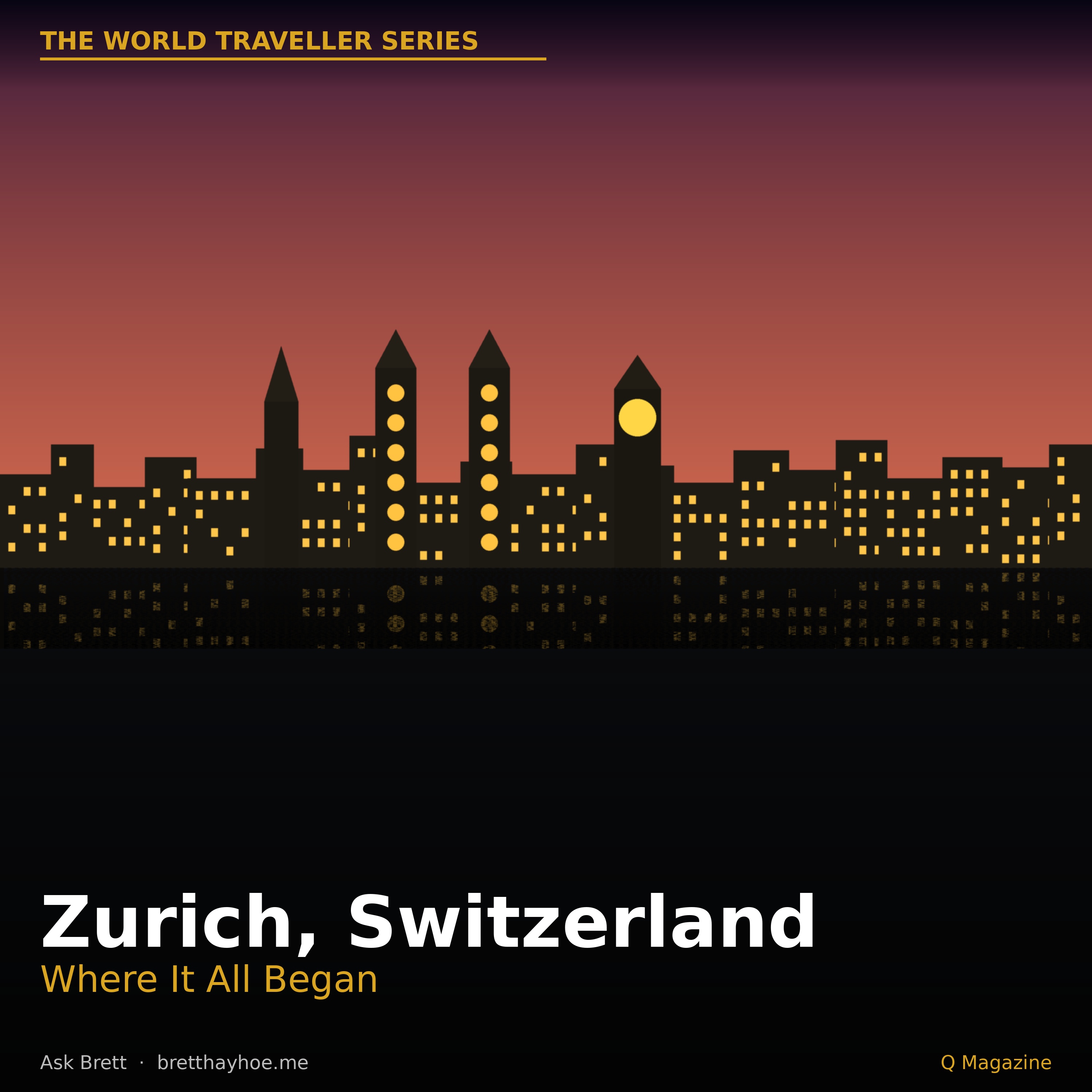
Zurich — The City

Zurich International Airport is something to behold, matched only by its efficiency. It ran, as one might expect, like a Swiss watch — a cliché that exists because it is simply, immovably true. From the moment of arrival, the machinery of the place operated with a quiet precision that made every other airport feel slightly improvised by comparison.
The city itself rewards the traveller in equal measure. History-rich, architecturally spectacular, and genuinely welcoming to all and sundry — Zurich wears its beauty without ostentation. The old town unfolds along the banks of the Limmat River, medieval guild houses facing the water, church spires punctuating a skyline that has resisted the urge to modernise at the expense of what already exists.
One afternoon’s walk illustrated the scale of the region with unexpected clarity: following a path without particular intention, I found myself at the German border. Zurich is not a large city. What it lacks in scale it compensates for in concentrated quality.

A footnote on economics worth noting: home ownership in Zurich is among the lowest in the world. The banks own most of the buildings. It is a city of considerable wealth in which most residents are, technically, tenants. Whether this observation says more about Swiss banking or Swiss practicality is a question best left to the economists.
What it said to this particular visitor was that Zurich, for all its magnificence, would not be a place for the underfunded. The dollar exchange rate saw to that. It was, without question, one of the most expensive trips ever undertaken. The city was worth every franc. The bank balance took a more measured view.
The Conference
The conference itself was run with the same Swiss efficiency that characterised everything else about the city. InterPride — the international organisation that connects Pride events and organisations around the world — gathered its membership with the seriousness of purpose the occasion deserved, and the warmth that the LGBTIQA+ community reliably brings to its own gatherings.

Learning the architecture of an international organisation from the inside is not a process that lends itself to shortcuts. There were procedures to understand, histories to absorb, relationships to navigate, and a culture to read. The steep curve of those early days was made navigable by the people already within it — experienced, generous with their knowledge, and clearly committed to what the organisation existed to do.
It was, in the best sense, an education.
An International Incident — Of a Rather Different Kind
The city’s nightlife, like everything else in Zurich, was well-organised and entirely accessible. A downtown nightclub, an evening out, a conversation at the bar — all entirely unremarkable, right up until the moment they weren’t.
A man was met. A conversation was had. An invitation was extended and accepted, and the evening continued back at the hotel with what seemed, at the time, like the perfectly natural conclusion to a pleasant encounter.
It was only afterwards — at the point where money was requested — that the nature of the arrangement became clear. The naivety was complete and genuine. The thought that the gentleman in question might be a professional had not, in all honesty, crossed the mind once.
What followed was a call to reception, the arrival of security, and a less than dignified exit by the individual concerned. He had made one miscalculation, and it proved fatal to his position: he assumed the guest was in the closet. The hotel, however, was entirely aware of the nature and identity of the contingent staying within its walls, and supported its guests without hesitation or qualification.
The matter was resolved. The evening was salvaged. The naivety, it must be said, did not entirely survive the experience.
The Vote — and What Followed
The most significant moment of the Zurich conference arrived not in a nightclub or on a cobblestoned street, but in a meeting room — and it arrived with rather more turbulence than anyone in it would have preferred.
InterPride’s constitution contained clear provisions regarding under-represented regions. Acting on those provisions, the then-President initiated proceedings to appoint two regional representatives without the usual election process: myself, for our region, and Hans from Belgium, for his.
The room did not receive this without objection. Dissent was vocal, and a verbal brawl ensued — the kind of procedural argument that organisations occasionally produce when principle meets politics and neither side is inclined to yield quietly. Both Hans and I sat through it, present in the room, acutely and uncomfortably aware that we were simultaneously the subject of the debate and powerless to resolve it.
The ending, when it came, was a happy one. Both appointments were confirmed. The objections were outvoted. Hans and I took our seats as regional representatives, and the rest, as they say, is history.

Conclusion
That meeting in Zurich was the beginning of twelve years serving the LGBTIQA+ community on the world stage.
Two terms — four years — as Region 20 Representative. Two terms as Secretary. Two terms as Co-President. Six roles across a dozen years, each one growing from the last, all of it traceable back to a single filing exercise in Melbourne and a decision by a board to send someone to Switzerland.
Zurich itself remains one of the most singular cities encountered in a lifetime of travel — expensive, beautiful, efficient to the point of elegance, and possessed of a history that reveals itself slowly, to those willing to walk its streets without a particular destination in mind.
It is, in every sense, where it all began.
The World Traveller Series is written and produced by Brett Hayhoe — publisher, editor and administrator of Q Magazine.
Read more at Q Magazine
Blogs — Ask Brett
Podcasts — Ask Brett and YouTube
Next: The USA entries begin — Long Beach, California, and a friendship with a lesbian couple in Los Angeles that has lasted the test of time.
Discover more from Ask Brett
Subscribe to get the latest posts sent to your email.