

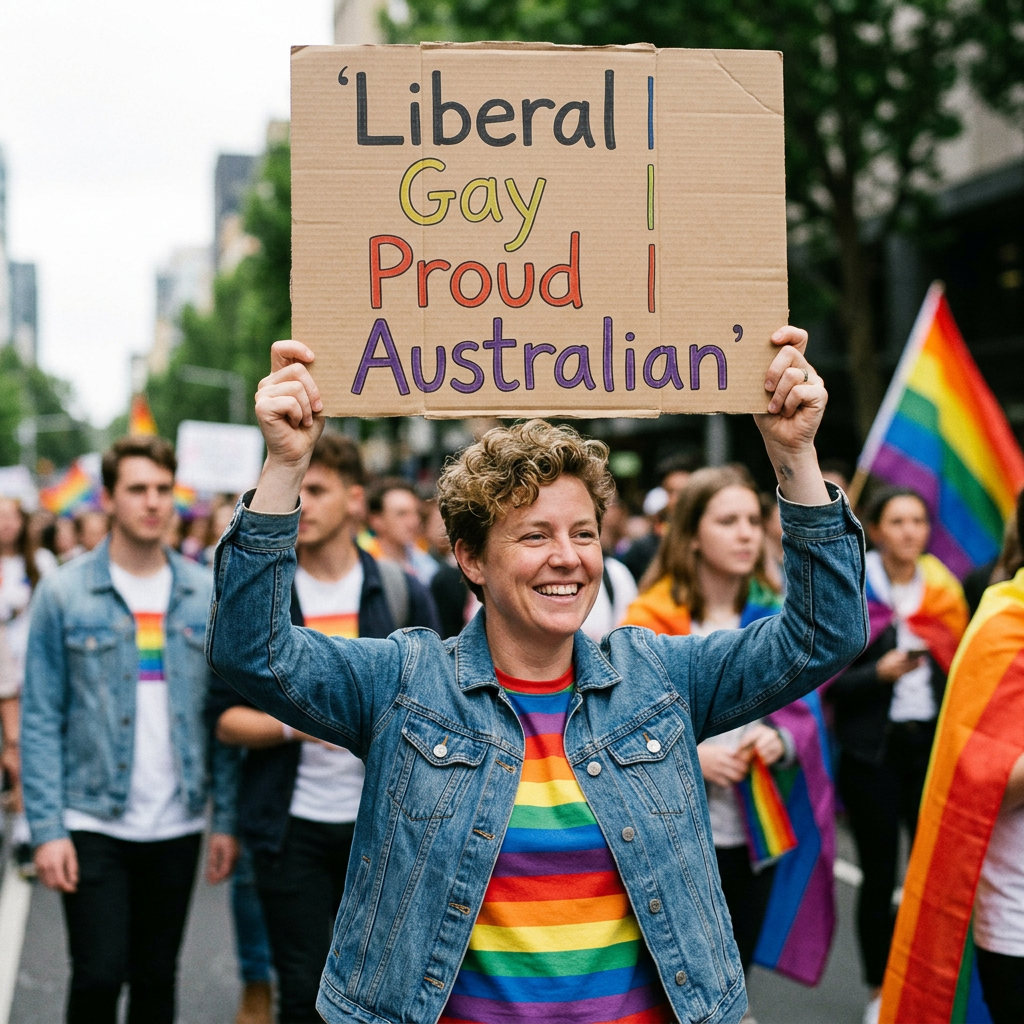
*by Brett Hayhoe | Published May 2026
Introduction
Imagine being told, from two directions at once, that you don’t really exist.
From one side, some members of your own party look at you with discomfort — a reminder of something they’d rather not think about, a complication in a worldview that prefers its categories tidy. From the other side, a community that knows better than most what it means to be excluded tells you that your politics make you a traitor, a self-hater, or at the very least a useful idiot for the forces that would see LGBTIQA+ rights wound back.
Gay Liberals — and gay conservatives more broadly — occupy one of the most uncomfortable intersections in Australian political life. They are neither fish nor fowl to those who need their identities to arrive in pre-packaged bundles. And yet they exist in significant numbers, they always have, and the refusal of both sides to fully make room for them says something important — not just about tolerance, but about how shallow tolerance can be when it only extends to people who confirm what we already believe.

Unwelcome at the Rainbow Table
Let’s be honest about what happens to gay and gender-diverse people who come out as conservative in LGBTIQA+ spaces. It is not pretty, and pretending otherwise serves nobody.
The LGBTIQA+ community has, with enormous courage and at considerable cost, built a political identity over decades of activism. That identity is broadly progressive — and for understandable historical reasons. It was progressive politicians who championed marriage equality, anti-discrimination protections, and LGBTIQA+ health funding when conservative parties were, at best, dragging their feet and, at worst, actively legislating against queer lives. That history is real and it matters.
But history is not destiny, and a community that has suffered exclusion should be the last to practice it. When gay conservatives are mocked, dismissed, or socially ostracised within LGBTIQA+ spaces — when they are told their politics invalidate their identity, or that they are somehow not “authentically” queer — the community is doing to them precisely what has been done to queer people for generations: demanding conformity as the price of belonging.
The irony is not subtle. The entire architecture of queer liberation is built on the principle that identity cannot be policed from the outside. A person does not get to tell another person who they really are. Applied consistently, that principle protects gay conservatives just as surely as anyone else. A queer person’s politics are theirs to determine. Their identity is not up for a community vote.

Unwelcome in the Party Room
The discrimination runs in the other direction too, and to deny it is equally dishonest.
The Liberal Party of Australia has historically housed a significant conservative religious faction — one that fought marriage equality to the end, that has opposed anti-discrimination protections for LGBTIQA+ people, and that continues to advocate for religious exemptions that would permit discrimination against queer Australians in employment, education, and services. For gay Liberals, navigating this internal culture is not an abstract ideological exercise. It is personal. It involves sitting in party meetings where colleagues speak of their identity as a problem, a threat, or a sin. It involves weighing whether to come out at preselection, whether being open will cost them branch support, whether the party they believe in has room for them as they actually are.
Some prominent gay Liberals have spoken publicly about this experience. Others have remained guarded — not because they are ashamed, but because they have made a rational calculation about the costs of visibility in an environment that has not always been safe. That calculation is one that no person should have to make in their own political home.
The closet is for clothes. A political party that quietly asks its gay members to stay in one — to be useful, to campaign, to doorknock, but not to be too visible about who they are — is not practising the broad church it preaches. It is practising a narrowness dressed up in the language of tolerance.

The Broad Church Needs All Its Pews
The Liberal Party has long described itself as a “broad church” — a coalition of classical liberals, social conservatives, moderates, and libertarians, united by a belief in individual freedom, enterprise, and limited government. It is a genuinely useful concept, and when it functions well, it has produced some of the most effective centre-right governance in Australia’s history.
But a broad church that quietly excludes gay members from full participation is not broad. It is a church with some pews roped off.
The practical cost is not merely one of fairness, though fairness alone should be sufficient. It is strategic and electoral. Australia has changed. Marriage equality passed in 2017 with nearly 62 percent of the vote — a result that represented not just a social shift but a generational realignment in what Australians expect from their political institutions. A party that cannot visibly, warmly, and genuinely include LGBTIQA+ members and candidates will increasingly struggle to speak to a voting public for whom queer acceptance is a baseline expectation rather than a contested position.
More than that: a party of individual freedom that does not extend that freedom to its own members’ identities has a philosophical contradiction at its core. If the Liberal Party believes in the individual’s right to live as they choose, free from undue interference — a principle it applies readily to economic and lifestyle choices — then that belief must extend to who a person loves and who they are. Anything less is not conservatism. It is selective libertarianism, which is just a polished form of prejudice.

Victoria Leads the Way: Liberal Pride and a Party in Metamorphosis
If the national picture is complicated, the Victorian Division of the Liberal Party offers something that looks considerably more like hope — and a model that the rest of the party would do well to study.
The Liberal Party of Australia (Victorian Division) has, over many years, built a genuine culture of inclusion that is neither performative nor reluctant. Victoria is home to Liberal Pride — the only dedicated LGBTIQA+ branch of the Liberal Party anywhere in Australia. Its very existence is a statement: that being gay and being Liberal are not identities that need to be reconciled in private, managed carefully in public, or apologised for in either direction. Liberal Pride has provided a formal home within the party structure for LGBTIQA+ members, created a visible signal to queer Australians that conservatism and inclusion are not mutually exclusive, and — perhaps most importantly — normalised gay membership within the broader Victorian branch culture in a way that organic, individual visibility alone could not achieve.
The Victorian Division has also demonstrated something the national party has sometimes struggled to articulate: that a long history of embracing gay members is not a concession to progressive politics. It is an expression of the Liberal Party’s foundational commitment to individual dignity and freedom. Gay Liberals in Victoria have not been tolerated at the margins. They have been elected, preselected, appointed, and promoted — and the party has been stronger for it.
Equally significant is the broader metamorphosis that the Liberal Party — and particularly its Victorian Division — has undergone in recent years. The party has moved, deliberately and with growing conviction, toward genuinely reflecting the diversity of modern Australia: welcoming members and candidates regardless of gender, race, religious belief, sexuality, or vocational background. This is not the language of a party grudgingly conceding ground. It is the language of a party beginning to understand that its principles — individual freedom, personal responsibility, the right to live and work as you choose — were always big enough to include everyone. The task has been to make the culture catch up with the philosophy.
That metamorphosis is ongoing and, in places, incomplete. But the trajectory is clear, and Victoria’s example shows what is possible when a division decides that inclusion is a value rather than an obligation.

The Path Forward
The path forward requires honesty from both sides — and courage from within.
Within the Liberal Party, that means visible, senior figures speaking plainly: gay Liberals are welcome, their identities are not a complication to be managed, and the party’s commitment to individual freedom applies to them without asterisks. It means preselection processes that do not quietly penalise candidates for being openly queer. It means a decisive, public reckoning with the religious conservative faction’s ongoing push for exemptions that would permit discrimination — and a clear statement that the party will not trade its gay members’ dignity for factional peace.
Within the LGBTIQA+ community, it means extending to gay conservatives the same principle the community rightly demands for itself: that identity is not conditional on politics. It means making room at the table for people who disagree on economic policy, on the role of government, on tax and regulation and national security — while sharing the fundamental commitment to queer dignity and visibility. It means resisting the temptation to treat ideological conformity as a membership requirement, because that is precisely the logic that has been used against queer people for generations.
And for gay Liberals themselves — it means, where it is safe to do so, being visible. Not for spectacle, not for the comfort of either side, but because visibility is the most powerful argument. Every out gay Liberal who serves well, leads effectively, and is unambiguously accepted within their party makes it harder to sustain the fiction that these identities are incompatible. Closets are for clothes. The rest of us need you in the room.

Conclusion
There is nothing contradictory about being gay and conservative. One is an identity; the other is a set of beliefs about how society should be organised. People contain multitudes. They always have. The discomfort that both sides sometimes feel about gay Liberals is not really about gay Liberals at all — it is about the anxiety that arises when a person refuses to fit the story we’ve told ourselves about who belongs where.
Australia’s political culture will be stronger when its conservative party is genuinely open to LGBTIQA+ members — not as a concession, not as a PR exercise, but as a natural expression of the individual freedom it claims to champion. And the LGBTIQA+ community will be truer to its own best values when it extends the welcome it has fought so hard to receive.
The closet has never made anyone safer. Openness — uncomfortable, complicated, occasionally argumentative openness — is the only foundation on which real belonging is built.
❓ Frequently Asked Questions
Q: Are there actually openly gay members of the Liberal Party of Australia?
A: Yes. Several Liberal MPs and senators have been openly gay or have come out during their careers. However, the experience of many gay Liberals is that openness carries real social and political costs within parts of the party, particularly in conservative-dominated branches and states.
Q: Didn’t the Liberal Party oppose marriage equality? How can gay people support it?
A: The party’s leadership under Malcolm Turnbull supported marriage equality, and many individual Liberal MPs voted yes in the 2017 parliamentary vote that followed the postal survey. However, a significant faction — including some senior figures — campaigned and voted against it. Gay Liberals tend to hold a range of views on how to weigh this history against their broader political values, just as voters of any background weigh competing priorities.
Q: Is discrimination against gay conservatives within the LGBTIQA+ community common?
A: It is well-documented anecdotally, though difficult to quantify. Gay conservatives frequently report social exclusion, mockery, or hostility in LGBTIQA+ community spaces when their politics become known. Community organisations have been criticised for failing to include conservative or religious LGBTIQA+ voices in advocacy and programming.
Q: What is the “broad church” concept in the Liberal Party?
A: The term describes the Liberal Party’s self-understanding as a coalition of different conservative and liberal traditions — economic liberals, social conservatives, moderate progressives — united by broad principles rather than ideological uniformity. Critics argue the church has been considerably less broad in practice when it comes to LGBTIQA+ inclusion.
Q: Does being gay affect a Liberal’s chances of preselection?
A: Formally, no — the party has no policy that discriminates on this basis. In practice, preselection is decided by branch members whose views vary significantly. In conservative-dominated branches, being openly gay has historically been a disadvantage for some candidates. This varies considerably by state and electorate.
Q: Why does this matter for the Liberal Party’s electoral future?
A: Australian voters — particularly younger voters and those in metropolitan and inner-suburban electorates — increasingly regard LGBTIQA+ inclusion as a baseline expectation. The rise of “teal” independents, many of whom won seats from the Liberals on social issues including LGBTIQA+ rights, signals that the party’s internal culture on these questions has real electoral consequences.
Q: What can gay Liberals do to drive change within the party?
A: Visibility is the most cited answer — being openly queer in branch meetings, preselection contests, and public roles normalises LGBTIQA+ membership within the party culture. Building networks with like-minded moderates, engaging in internal policy debates, and making the philosophical case that individual freedom must include sexual orientation and gender identity are all part of the longer work of cultural change within the party.
Q: What is Liberal Pride, and why does it matter?
A: Liberal Pride is the only dedicated LGBTIQA+ branch of the Liberal Party of Australia, operating within the Victorian Division. Its existence matters for several reasons: it provides a formal, recognised home for LGBTIQA+ Liberals within the party structure; it sends a clear public signal that conservative politics and queer identity are compatible; and it has helped normalise gay membership across the broader Victorian branch culture. No other state division of the Liberal Party has established an equivalent body, making Victoria’s lead all the more significant.
Q: Is the Victorian Division of the Liberal Party genuinely more inclusive than other divisions?
A: By most available indicators, yes. The Victorian Division has a longer and more consistent record of openly gay members participating at senior levels, and is the only division to have formalised LGBTIQA+ inclusion through a dedicated branch. The party’s broader metamorphosis — toward welcoming members regardless of gender, race, religion, sexuality, or vocational background — is also more visibly advanced in Victoria than in some other states.
Discover more from Ask Brett
Subscribe to get the latest posts sent to your email.
